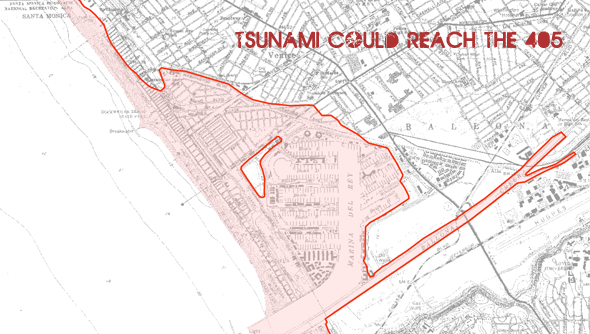
Click to see full sized image - Venice Beach Quadrangle Tsunami Inundation map
FULL TSUNAMI PREPARATION FACTS AND DRILL INFORMATION BELOW
The day the tsunami wave was projected to reach Venice Beach, LAPD was on the scene at Venice Pier, helicopters overhead warning people to evacuate from the coastline. LAFD had rescue rafts at the ready, and the Coast Guard had multiple boats and helicopters in the air at the ready in the event anyone’s safety was at risk. Had we suffered the same fate as Santa Cruz or other cities north of us, they would have been busy as hundreds crowded the parking lots by the closed piers and beach areas to see the wave come in. Surfers were even rushing out into the water against LAPD and Lifeguard warnings to catch the big one.
Now, being reasonable, it was widely reported that we were not expected to be in real danger. As a man was swept out to sea in northern California trying to photograph the incoming wave, and people with their young children were reported all along the coast going to spectate the event, it calls our ability to put our own safety and the safety of our loved ones above gawking at an incoming spectacle. Especially one that could kill you and devastate property.
For Tsunami Awareness Week, the following updated map and information shows the projected inundation area for the Venice Beach Quadrangle. As you can see by the area shown in red ( download the whole document here ), a tsunami wave could reach as far as the 405 freeway, flooding and sweeping everything in its path along the way. Please take a moment to review this document, and in the event a quake strikes another part of the globe, or even here at home resulting in a tsunami warning - let better reasoning prevail and please move to safety, and not to spectate! Make a tsunami preparation plan that includes food, water and collecting and moving your animals and family to a point of safety.
What to do:

Click for printable Tsunami Safety Diagram
Millions of people enjoy California’s wonderful coastline. Whether you live, work, or visit, it is important to be aware that the coastal region is vulnerable to tsunamis. California’s large active offshore faults and unstable submarine slopes can cause tsunami activity along the coast.
Strong ground shaking from an earthquake is the natural warning that a tsunami might be coming. If you are on the beach or in a harbor and feel an earthquake, immediately move inland or go to high ground. If strong shaking lasts for 20 seconds or more, everyone within the tsunami evacuation area should evacuate as soon as it is safe to do so. Other natural warnings include seeing the ocean quickly recede to expose the ocean bottom, or hearing an unusually loud roar coming from the ocean. A tsunami can arrive within minutes and may last for several hours.
For tsunamis coming from across the ocean, local communities use a variety of communication methods to broadcast emergency information. Be informed on what signals, sirens, and public services will be employed for your area. Practice tsunami evacuation drills.
Locally generated tsunamis in California include:
- January 26, 1700 - A magnitude 9 earthquake along California’s north coast generated a major tsunami. Oral histories of Native Americans in this region incorporate recollections from this event.
- December 21, 1812 - A local earthquake triggered a tsunami near Santa Barbara. Residents in coastal villages were so alarmed that they retreated several miles inland to the nearby Santa Barbara Mission.
- November 4, 1927 - A magnitude 7.1 earthquake off the coast of northern Santa Barbara County caused a six-foot-high tsunami along portions of the central coast.
Tsunami Preparedness
First, find out if you live, work or play in a tsunami hazard area ( VENICE BEACH IS A HAZARD AREA ):
- Use the links listed below to find out where tsunami hazard zones occur.
- Information from these websites can help you identify the tsunami hazard area in your community and help you prepare. Check out the county web pages on the CGS website for evacuation plans for your community. If you are located just outside of a tsunami hazard area, you may consider working with your community to see what kind of assistance you might be able to provide for those that are in a tsunami hazard area and will need to relocate.
CGS website
http://www.consrv.ca.gov/cgs/geologic_hazards/Tsunami/Inundation_Maps/Pages/Statewide_Maps.aspx
CalEMA MyHazards
http://myhazards.calema.ca.gov/
North Coast (Del Norte and Humboldt Counties)
http://www.humboldt.edu/rctwg/site/projects/images/uploads/images/uploads/tsunamievaczone.pdf
Plan a Tsunami Evacuation Drill
- Identify if there is an evacuation plan in place for your site. Contact your building manager, school district, city or county offices to find out the recommended procedures. Additionally, the California Geological Survey Tsunami website provides many links to local, regional, state, and national information sources.
- If there is no evacuation plan in place, learn what the recommended tsunami evacuation routes are in your city, county and region. Some cities and counties have this information available online. Identify safety zone(s) near you, and plan your primary and secondary evacuation routes.
- Identify what your evacuation destination will be (school, church, parking lot).
- Prior to an evacuation drill, walk your evacuation route. Make sure there are no potential hazards that may prevent your staff/students/family from using this evacuation route safely.
- Coordinate in advance to have volunteer groups (from non evacuation areas) serve refreshments to evacuation drill participants. After the drill, have a safety fair planned: invite local emergency response groups, learn emergency preparedness skills, distribute tsunami and earthquake preparedness information.
- For school evacuation drills, plan for interactive educational tsunami activities at the relocation area (for ideas see CGS tsunami education link). Provide a snack. Have a guest speaker.
Know the warning signs
- An earthquake in your area is one of nature’s tsunami warning signals. Do not stay in low-lying coastal areas after a strong earthquake has been felt.
- Tsunamis are sometimes preceded by a noticeable receding of sea level as the ocean retreats seaward exposing the seafloor. A roar like an oncoming train may sometimes be heard as the tsunami wave rushes toward the shore. These are also nature’s tsunami warning signals.
- A tsunami is not a single wave, but a series of waves. Stay out of danger areas until an “all-clear” is issued by competent authority.
Understand how your community will broadcast official tsunami emergency information
- Tsunami warnings may be by radio, television, telephone, text message, door-to-door contact, NOAA weather radios, outdoor sirens.
- During a tsunami emergency, your local civil defense, police, and other emergency organizations will try to save your life. Give them your fullest cooperation.
- All warnings to the public must be taken very seriously, even if some are for non-destructive events. The tsunami of May 1960 killed 61 people in Hilo, Hawaii because some thought it was just another false alarm.
Be Prepared
- Look for the blue and white tsunami evacuation signs along the coast.
- Assemble a small evacuation kit (essential documents, medications, flashlight, portable NOAA weather radio and batteries, water, snack, warm clothes, silver “space blanket).
- Make a reunification plan with your family. Decide when and where you will meet if you are separated. Designate an out of state relative or friend for the individuals in your family to call if it is not possible to meet at your reunification spot.
- Make plans for how to address any needs or disabilities you might have.
- · For more information on how to prepare go to How to Survive a Tsunami
Contact other Emergency Response Groups in Your Area
- Consider joining your Community Emergency Response Team: www.csc.ca.gov/cc/cert.asp
- Find out if other organizations, agencies, or schools in your area are participating in a tsunami drill. Even if you are in an area that does not require evacuation, volunteer to work at relocation sites, comfort stations, or animal care facilities in your area. Learn what the potential needs of your community might be.
- Share ideas and coordinate resources. For example, your elementary school may need to evacuate to another school, church, or business; coordinate with them to work out details such as how to enter the site and where to assemble.
Important Online Resources
Official State Tsunami Hazard Zones:
CGS Tsunami Inundation Maps http://www.conservation.ca.gov/cgs/geologic_hazards/Tsunami/Inundation_Maps/Pages/Statewide_Maps.aspx
CalEMA MyHazards http://myhazards.calema.ca.gov/
Tsunami Education
CGS Tsunami Education http://www.conservation.ca.gov/cgs/geologic_hazards/Tsunami/Pages/education.aspx
K-12 curriculum, activity sheets, and booklets
About Tsunamis
CGS Tsunami http://www.conservation.ca.gov/cgs/geologic_hazards/Tsunami/Inundation_Maps/Pages/Index.aspx
Redwood Coast Tsunami Working Group http://www.humboldt.edu/rctwg/site/projects/images/uploads/images/uploads/tsunamievaczone.pdf
NOAA Tsunami Warning Center http://wcatwc.arh.noaa.gov/
Preparing for earthquakes:
The Great California ShakeOut http://www.shakeout.org/
Earthquake Country Alliance http://www.earthquakecountry.info/
Dare to Prepare http://www.daretoprepare.org/
CalEMA http://cms.calema.ca.gov/prep_tsunami.aspx
Red Cross http://www.redcross.org/
Local County Office of Emergency Services (CGS Tsunami Inundation Map links)
More information for Tsunami Awareness and Preparedness Week
 |
National Tsunami Awareness and Preparedness Week
|
 |
|
| For emergency planners in coastal jurisdictions, the California Emergency Management Agency (CalEMA) and the California Geological Survey (CGS) are available to support you regarding tsunami hazards in California, including your public education and outreach efforts for Tsunami Awareness Week. For more information on Tsunami Awareness and Preparedness Week resources and support available from CGS and Cal EMA, contact: | |||
| Cindy Pridmore CGS Outreach/Seismic Hazards California Geological Survey 801 K Street, MS 12-31 Sacramento, CA 95814 916-324-5572 |
Kevin M. Miller Earthquake & Tsunami Program California Emergency Management Agency 1300 Clay Street, Suite 400, Oakland, CA 94612 510-286-0817
|
|
|

The California Geological Survey (CGS) provides geologic and seismic expertise to the public, other State government offices, such as the California Emergency Management Agency (CalEMA; formally known as the Governor’s Office of Emergency Services), and local government agencies (cities and counties). For tsunami hazards, CGS is working closely with CalEMA and the Tsunami Research Center at the University of Southern California to produce statewide tsunami inundation maps and preparedness information for California. CGS is also the Scientific Representative for California on the National Tsunami Hazard Mitigation Program Coordinating Committee, a state and federal cooperative responsible for developing policies and standards for tsunami mitigation efforts in the United States and its territories.


Speak Your Mind
You must be logged in to post a comment.